Tag
24 February 2026

Health is everything

and we are not at the centre of that everything

Prof. Dr Evelyne de Leeuw felt like conducting an experiment and, for that reason, chose to study Health Sciences in 1981. That stubbornness later became the common thread in her career. After positions in Denmark and Australia, she now conducts research in Canada on how the health of humans, animals and ecosystems is interconnected. On 26 February, she returns to Maastricht to give a lecture at the Catharina Pijls Prize ceremony. How does De Leeuw look back on her sometimes winding career path, and what does she want to pass on to others?

The faded dream of becoming a doctor

Conducting research was never De Leeuw’s plan. As a child, she was determined: one day she would become a doctor. Her fascination with hospitals arose from her chronic intestinal inflammation, ulcerative colitis. “This condition hardly occurs in young children, so I wasan interesting case for scientists. During my many hospital visits, I became fascinated by healthcare and everything surrounding it.”

However, during an open day at a Medicine programme, doubts set in. “I am actually not such a caring type,” De Leeuw admits. “And I did not see myself spending my whole life speaking sympathetically to people with headaches or ingrowing toenails.” Her career plan fell apart. The programme Tropical Cultural Engineering was not a success either, and she was rejected from Landscape Architecture due to a shortage of places. “I had no idea what I wanted to do with my life.”

De Leeuw’s father intervened by sending her to a psychological testing agency. “There I was told that I can do many things, as long as I enjoy them.” The agency pointed her towards an experimental programme in Maastricht: Social Health Sciences. “They assured me it was not a medical degree, but that it was about health. And, they said, health is everything: from planet and microbiology to policy.”

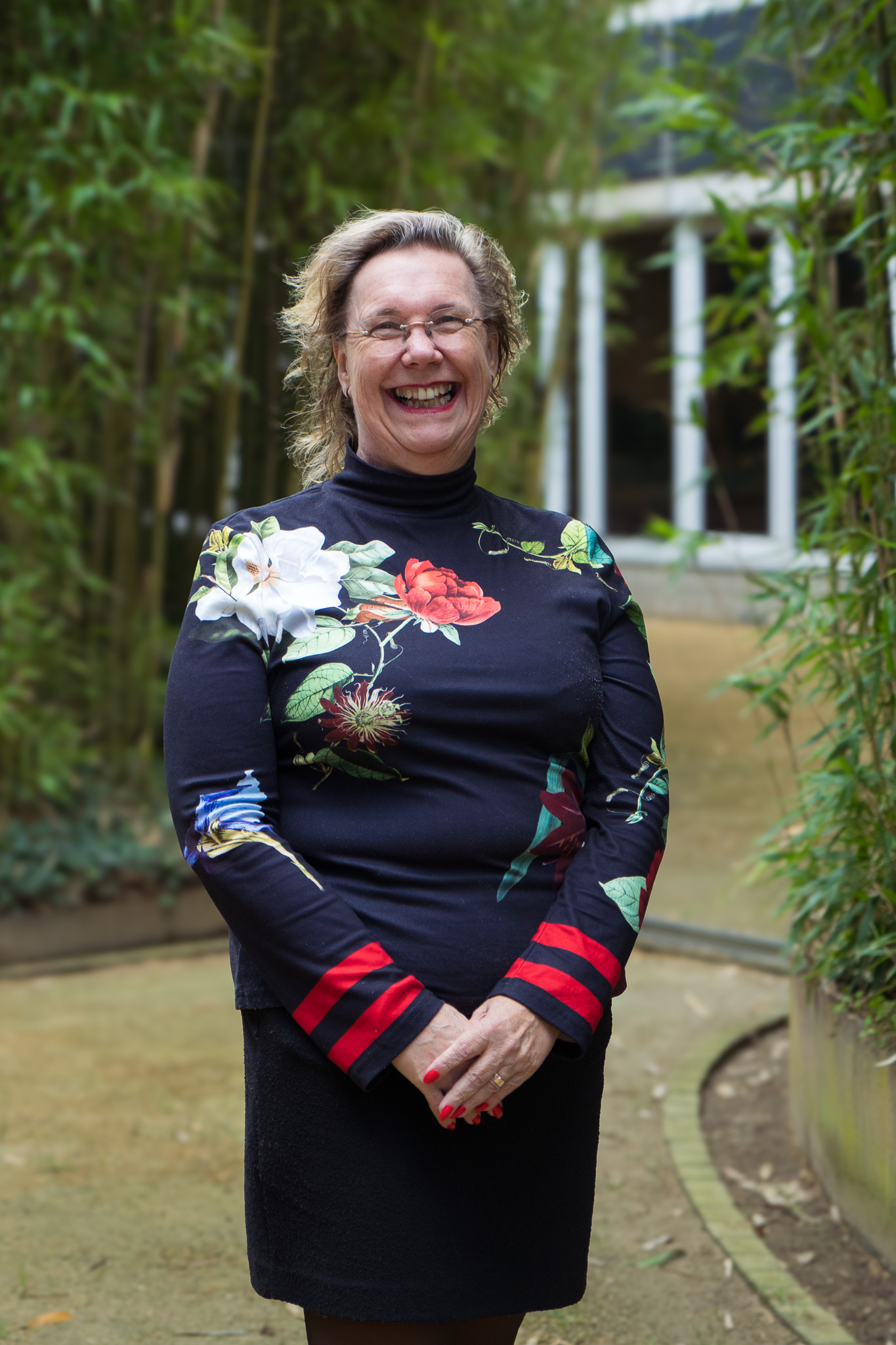
De Leeuw at the Universiteitssingel 50.

“Problembased learning saved me. For six weeks, we first learned how to learn. That was exactly what I needed.”

First scientific publication

That choice of study turned out to be the right move. “Problem based learning saved me,” De Leeuw laughs. “For six weeks, we first learned how to learn. That was exactly what I needed.” Content-wise as well, De Leeuw quickly found her direction. In her first year, she wrote an essay about DES daughters: women who faced significant health risks because their mothers had used the hormone preparation DES to prevent miscarriages. Epidemiology professor Paul Knipschild encouraged her to publish the piece. “After that publication, entering academia seemed, for the first time, a good option.”

An unintended PhD

After her studies, De Leeuw went to Berkeley inCalifornia. “The programme in Maastricht was seen as an ‘experimentalprogramme’, whereas this field has existed for more than a century in manyother countries. I was curious to see how the field really works.” Undertakinga PhD was not on her list, but it turned out to be a practical solution. “If Iwrote a thesis after that year, I could receive funding for my studies inAmerica.” 

For her thesis, De Leeuw was inspired by a new idea about health promotion. “In the 1980s, the WHO argued that health benefits from systemic changes rather than behavioural advice. Healthy choices should be easier than unhealthy ones.” De Leeuw examined whether healthy government policy in the Netherlands was feasible. But just before she put the final letter on paper, the cabinet fell. “The political focus suddenly shifted from improving health to saving healthcare costs.” By adding an extra chapter to her thesis, she fortunately still managed to obtain her PhD on the topic.

De Leeuw during her graduation 1986.

An unintended PhD

Healthy cities

During her PhD trajectory, De Leeuw encountered the idea of healthy cities. It appeared that health policy is better realised locally than nationally, for example by developing policy at city level. “The idea of healthy cities grew into a worldwide network of at least 20,000 cities. Every city is unique; they can be found in Japan, the Philippines, Africa, theNetherlands, and so on.”

What constitutes a healthy city differs from place to place. Each municipality focuses on different ecological and health aspects. It is clear, however, that it is important to have certain facilities within reach, particularly nature. “We increasingly understand how biodiversity influences our health,” De Leeuw explains. “More contact with nature is associated, for example, with a healthier gut microbiome. Children who play outside more often even have a healthier microbiome throughout their lives.”

Being ahead of the troops

After 20 years of conducting research in Australia, De Leeuw retired, although she only maintained that status for half a year. When the Université de Montréal asked her to take up the Canada Excellence in Research Chair, she did not hesitate. “Here, I am allowed to do unusual and new work,” she says, smiling. “We look at how health systems at all levels are interconnected: spiritual, ecological, microbiotic, infrastructural and human systems. Topics such as fungi, green walls and the impact of outdoor play are addressed.”

De Leeuw feels completely at home in Canada, at a university that is open to creative ideas. “I am someone who often runs ahead of the troops, and here there is room for that. Although in the past, I was sometimes too early. In 2007, I wanted to investigate, for an Australian university, what local governments were doing to prepare for climate change.T he committee thought it was a ridiculous plan, but three years later the topic had become relevant.”

“Here,I am allowed to do unusual and new work. We look at how health systems at all levels are interconnected: spiritual,ecological, microbiotic, infrastructural and human systems."

Listening to fungi

On 26 February, De Leeuw returns to Maastricht to give a lecture at the Catharina Pijls Prize ceremony about the underground network of fungi. “The largest living organisms on Earth are fungi. In the forests of Oregon, a fungus — the sombre honey fungus — was discovered measuring almost nine square kilometres. It connects the entire ecosystem. That fungus shows that we are connected to everything else, whereas we as humans often think we stand at the centre of everything.”

This illustrates how De Leeuw prefers to view health: with less focus on human health itself and more attention to the ecosystem as a whole. “It is important that we no longer bend nature to our will, but instead ensure that nature, as it is, can influence our health.”

The circle is complete

That De Leeuw is able to give a lecture at the Catharina Pijls Prize ceremony feels to her like a circle completed. “My thesis was financed at the time by the Catharina Pijls Foundation. This foundation is therefore partly responsible for my career,” she laughs. “I think it is wonderful that I can do this at the university where I once studied.”

If there is one thing De Leeuw wants to pass on to present and future students and researchers, it is to dare to be different.“Problem based learning certainly helped me to dare to do that myself. UM acknowledged that everyone is unique and has their own passions. Without that encouragement, I would not have reached where I am today.”

BIO

Prof. Dr Evelyne de Leeuw has held the Canada Excellence in Research Chair at the Université de Montréal since 2023. She has received funding for this position for a period of eight years. She studiedHealth Sciences at Universiteit Limburg from 1981 to 1985. She then moved to the School of Public Health at the University of California, Berkeley. In Maastricht, she subsequently founded and ledthe WHO Collaborating Centre for Research on Healthy Cities. She then established a problem oriented School of Public Health in Denmark, after which she became Professor at three Australian universities. Her current research in Montréal focuses on the governance of the health of “everything and everyone” in cities.